 Trending
 AWS Bedrock & AI Services for Developers
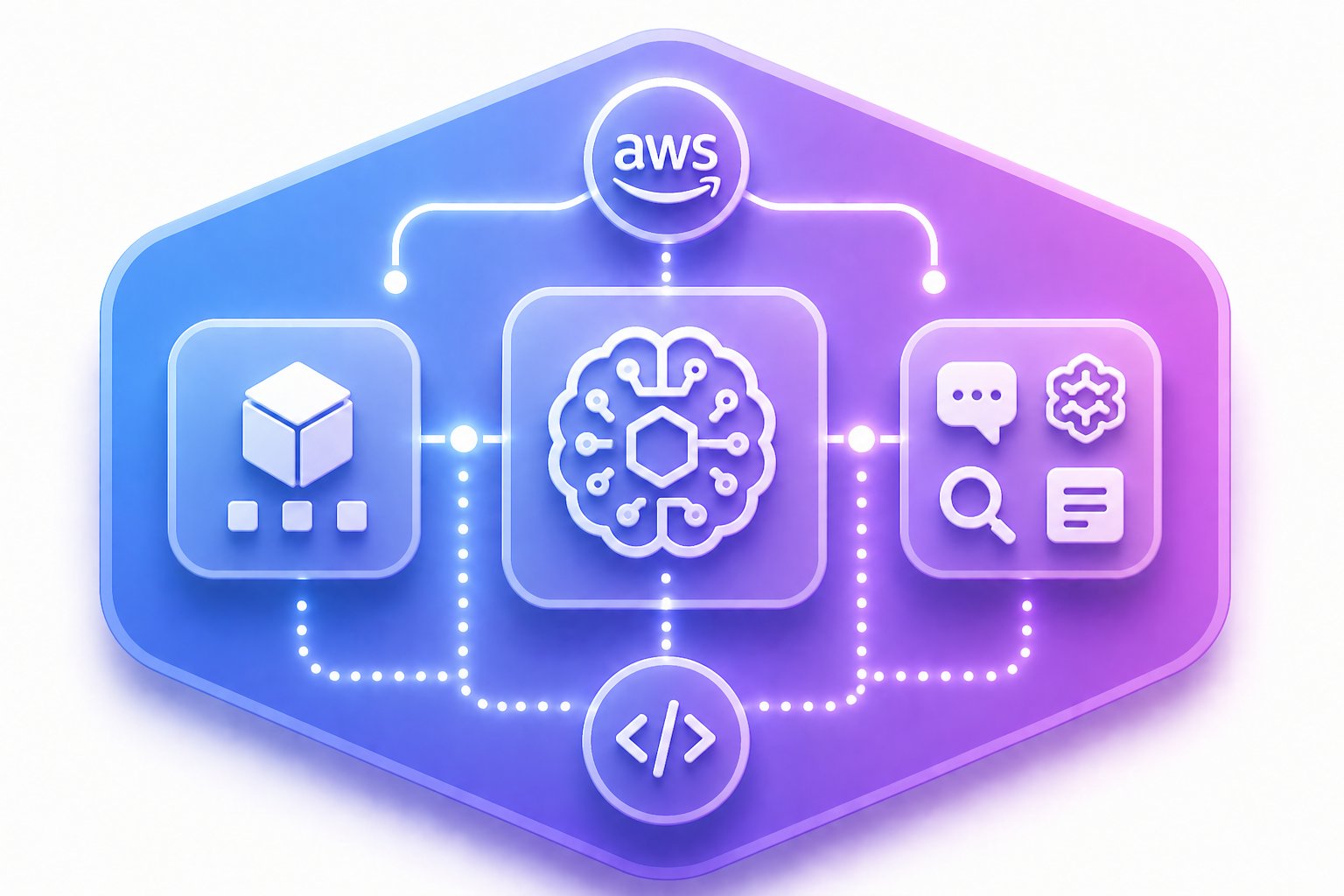
Deploy and use AI models on AWS: Bedrock (Claude, Llama, Titan), Lambda, API Gateway, S3, and DynamoDB. Build enterprise AI solutions integrated with your existing backend stack.

Oleksii Anzhiiak
Software Architect, Senior .NET Engineer & Co-Founder
By the end you'll be able to
- Use AWS Bedrock to call multiple model families (Anthropic, Meta, Amazon, Mistral) from one API
- Pick the right model for the right job — small / fast / cheap vs large / capable / expensive
- Wire AI into AWS-native architectures: Lambda, S3, DynamoDB, Step Functions
- Operate AI in production AWS — IAM, VPC, observability, cost dashboards
- Ship enterprise-shape AI features that the security team will sign off on
Is this course for you?
This is right for you if you…
- Your company is on AWS and Bedrock just became the path of least resistance for AI
- You're an SRE / DevOps / Cloud engineer wanting to add AI to your existing AWS work without changing employer
- You're shipping AI in regulated environments where managed services beat self-hosted infrastructure
Don't take this course if you…
- You're not on AWS — Bedrock is AWS-only. If you're on Azure, take #20; if you're vendor-agnostic, take #22 or #25
- You don't know AWS basics — IAM, Lambda, S3 are assumed. Take an AWS foundation course first if those words are unfamiliar
- You expect Bedrock to magically replace prompt engineering — it doesn't. Take #21 first
Who teaches this
Oleksii Anzhiiak
Software Architect, Senior .NET Engineer & Co-Founder
Oleksii Anzhiiak is a Software Architect, Senior .NET Engineer, and Co-Founder of ToyCRM.com and ProfectusLab. With over 15 years of experience, he specializes in distributed systems, cloud infrastructure, high-load backend development, and identity platforms. Oleksii designs complex architectures, builds secure authentication systems, and develops modern engineering education programs that help students achieve real career results.
Currently leads architecture for ToyCRM.com — a multi-tenant CRM platform built on .NET by our team. The same patterns and design decisions used there appear directly in the courses: identity & auth, distributed services, code review culture. You learn from engineers actively shipping production code, not from a textbook.
Syllabus
Build enterprise AI services on AWS in seven practical modules:
- 1 Module 1: AWS Bedrock fundamentals — model catalog, API access, pricing, quotas
- 2 Module 2: Invoking Claude, Llama, and Titan — prompting, parameters, streaming responses
- 3 Module 3: Lambda + API Gateway — serverless AI endpoints, cold starts, concurrency
- 4 Module 4: Knowledge bases with S3 + Bedrock — ingestion pipelines, managed RAG
- 5 Module 5: DynamoDB integration — session history, caching, cost-optimized storage
- 6 Module 6: IAM and security — least-privilege access, VPC endpoints, encryption
- 7 Module 7: Monitoring and cost control — CloudWatch, X-Ray, budget alarms, guardrails
Prerequisites
Backend experience required. AI-Powered .NET or LLM-Powered Apps recommended.
Backend development experience required (any language). Basic understanding of cloud concepts helpful.
What you'll build
You leave with an AI feature deployed inside an AWS-native architecture you designed yourself — Lambda + Bedrock + DynamoDB, observability dashboards, IAM roles, the works. The exact shape of project that gets the AWS-AI hiring premium in 2026.
- Bedrock SDK and the InvokeModel API
- Model selection: Claude, Llama, Titan, Mistral on Bedrock
- Bedrock Knowledge Bases (managed RAG) vs DIY
- AWS-native AI patterns: serverless, event-driven, batched
- Cost dashboards, IAM, observability, compliance
Where this fits in your career
Read alongside this course

The AI-Readiness Assessment a CTO Can Run in One Week
Before you write an AI strategy, measure what your organization can actually execute. A five-day, meeting-light assessment of your data, skills, tooling, and governance — with a scoring rubric you can defend to the board and to your engineers.

Running Claude on AWS Bedrock: When the Platform Route Beats Direct APIs
Same models, different operational contract. When Bedrock's IAM, VPC and unified billing earn their premium — and when the direct Anthropic API is the better engineering call. A decision guide for teams already on AWS.

Design Patterns in the AI Era: Why Pattern Literacy Matters More When You Don't Write the Code
AI writes the implementation; you review it. But you can only review what you can name. Pattern literacy — Strategy vs. a pile of ifs, Decorator vs. a copy-pasted wrapper — is turning from an architecture skill into the core reading skill of AI-assisted development.
First lesson on us. Decide after meeting your instructor.
Sit in on the first session. If after lesson 1 you decide the instructor isn't the right fit, you don't pay for it — and no awkward conversation. (Trial offer applies to courses with more than 5 lessons; this one qualifies.)
Pricing & what's included
What's included
- 14 live sessions × 2 hours each — taught by the instructor, not a recording playback
- Slide deck for every session — yours to keep and refer back to
- Working code files and any data files used in class — cloned to your machine
- Weekly homework with personal code review from the instructor
- Recording on request — give the teacher a heads-up ("can't make Tuesday, please record it") and the session is recorded for you
Frequently asked questions
How much time per week will this take?
Plan for the live sessions plus roughly 1.5–2 hours of practice per session. Most students who finish on schedule put in 4–6 hours a week total. If you put in less, you still finish — it just takes longer.
What if I miss a class?
Tell the teacher BEFORE the session — "I can't make Tuesday, please record it" — and the teacher records that lesson and sends it to you. Recordings aren't a default catch-up archive; they're produced on request when you give a heads-up. After the lesson you do the homework, bring questions to the next session.
What's included in the price?
Live sessions with the teacher; the slide deck for each session (yours to keep); the working code files and any data files used in class; weekly homework with code review; and recordings of the sessions you give advance notice for. Anything beyond that — a certificate, alumni access, mock interviews — is listed explicitly in "What's included" above the FAQ for the courses where it applies.
What if I sign up and the teacher isn't a fit?
For courses with more than 5 lessons, the first session is effectively a trial — if after lesson 1 you decide the teacher isn't a fit, you don't pay for it. We'd rather you walk away after one lesson than push through 9 weeks of bad chemistry. (Courses with 5 or fewer lessons are short enough that the standard pricing applies — the trial offer doesn't make sense at that length.)
Can I get a refund partway through?
Yes. Within 14 calendar days of purchase you can withdraw and get a full refund on request, no reason needed — that's your statutory right under Georgian consumer-protection law. On top of that, our own guarantee: if you've attended fewer than 3 lessons, we refund in full with no deductions. Refunds go back to your original payment method within 14 days.
Can I switch the language of instruction?
The live sessions run in the language listed under "Available Languages" above. Slides and code files are typically available in all four (English, Russian, Ukrainian, Georgian). Many students attend sessions in one language and read materials in another — that's normal.
Will I be ready for a real job after this course?
One course rarely gets anyone hired by itself — for any field. What this course gives you is the foundation a junior hiring manager expects: working code you wrote yourself, the vocabulary to read other people's code, and the practice habits that make you employable. The honest answer to "am I ready?" is on our roadmap (link in the page header) — open the level you want to reach and read the "You're ready when" checklist.
Can I pay in instalments?
Yes for courses with a "Monthly Payment" option in the at-a-glance ribbon — usually two or three equal monthly payments. Courses without that option are paid in one go. If the price is the blocker, write to us — we look at every case.
You may also like

Intermediate
Backend Architecture Foundations
A practical backend course focused on architecture thinking. Learn how to design scalable systems, choose between monoliths and microservices, build clean APIs, implement authentication correctly, and think in production-ready systems.

Advanced
Building MCP Servers & AI Tool Integrations
Master the Model Context Protocol (MCP) — Anthropic's open standard for connecting AI models to external tools and data. Build custom MCP servers, expose APIs to Claude, and architect next-gen AI integrations.

Intermediate
Building with Claude API: Production AI Apps with the Anthropic SDK
Master Anthropic's Claude API end-to-end: messages API, prompt caching, tool use, extended thinking, streaming, batch processing, files, citations, and vision. Build cost-efficient, production-grade AI features in any backend.