Honest takes on architecture, AI, and the developer career — written by senior engineers with deep production experience.
Every article comes from real production systems. No ghostwriters, no SEO churn, no AI filler. If a topic isn't here, it's because we haven't lived it yet.
23 articles · 4 languages · 7 min average read

What Is IT, Really? A Plain-Language Map of the Four Career Paths
If you're new to IT or just landed from search, read this first. It explains the whole site's mental model — four tracks, five career stages, restaurant analogies — in five minutes.
Nothing matches that filter
Try removing one — or click "All articles" to see everything.
Latest
Three most recent — regardless of track.

The AI-Readiness Assessment a CTO Can Run in One Week
Before you write an AI strategy, measure what your organization can actually execute. A five-day, meeting-light assessment of your data, skills, tooling, and governance — with a scoring rubric you can defend to the board and to your engineers.

Running Claude on AWS Bedrock: When the Platform Route Beats Direct APIs
Same models, different operational contract. When Bedrock's IAM, VPC and unified billing earn their premium — and when the direct Anthropic API is the better engineering call. A decision guide for teams already on AWS.

Design Patterns in the AI Era: Why Pattern Literacy Matters More When You Don't Write the Code
AI writes the implementation; you review it. But you can only review what you can name. Pattern literacy — Strategy vs. a pile of ifs, Decorator vs. a copy-pasted wrapper — is turning from an architecture skill into the core reading skill of AI-assisted development.
Featured Articles
Cornerstone reads. If you only have time for three, start here.
Token Economics: The Discipline That Decides Whether Your Agent Ships or Gets Shut Down
Agent systems don't usually die because they're wrong. They die because they're wrong about money. Token economics — budgeting, caching, batching, and model routing as design decisions — is the sixth discipline of production AI engineering, and the one finance will audit.
Durable Execution for Agents: The Fifth Discipline Your .NET Background Already Prepared You For
Spec is the truth. Context is the assembly. Evals are the proof. OpenSpec is the operating system. The substrate underneath — the thing that keeps a multi-step agent alive across retries, restarts, and the human-in-the-loop who walks away from their desk at 5pm — is durable execution. Every .NET engineer who's ever shipped a MassTransit saga already understands the pattern; here's how it maps onto serious AI agents in 2026, and why it's the fifth discipline that finally closes the arc.

OpenSpec in 2026: The Operating System for Spec-Driven Development
Six weeks ago I installed @fission-ai/openspec. Yesterday I shipped a 14-file change in 90 minutes from a 200-line spec, in a brownfield codebase three engineers have been editing for two years — no merge conflicts, no review escalation. This is the senior-architect deep-dive on why OpenSpec is the first SDD tool that doesn't collapse under production reality.
Stay in the loop
Three free ways to stay close to what we ship.
Subscribe on Telegram
Weekly architecture notes in your language. New article? A pattern we shipped to production this week? It hits the channel before anywhere else.
Open the channelFree 30-min call
Talk with a senior engineer from our team. Career-changers and team leaders welcome. No sales pitch — we listen, then suggest.
Book the callPick your track
Five minutes with the roadmap. The honest version of which IT track fits which kind of person.
Open the roadmapAll Articles
Grouped by career track. Click a track tab above to filter the whole page.
Backend 18
The AI-Readiness Assessment a CTO Can Run in One Week
Before you write an AI strategy, measure what your organization can actually execute. A five-day, meeting-light assessment of your data, skills, tooling, and governance — with a scoring rubric you can defend to the board and to your engineers.
Running Claude on AWS Bedrock: When the Platform Route Beats Direct APIs
Same models, different operational contract. When Bedrock's IAM, VPC and unified billing earn their premium — and when the direct Anthropic API is the better engineering call. A decision guide for teams already on AWS.
Design Patterns in the AI Era: Why Pattern Literacy Matters More When You Don't Write the Code
AI writes the implementation; you review it. But you can only review what you can name. Pattern literacy — Strategy vs. a pile of ifs, Decorator vs. a copy-pasted wrapper — is turning from an architecture skill into the core reading skill of AI-assisted development.
MCP for Engineering Teams: Connecting Your Internal APIs to AI Without Regretting It
The developer explainer told you what MCP is. This is the other conversation — the one for whoever owns the systems: what connecting internal APIs to AI actually costs, where the security boundary belongs, and when to build the integration in-house versus bringing in review.
Rolling Out AI Coding Tools to an Engineering Team Without Wrecking Code Review
Buying licenses is the easy part. The teams that get real value from AI coding tools treat the rollout as an engineering project: evaluation on their own codebase, review guardrails, a policy people actually read, and honest measurement. Here's the playbook I use.

SQL: The First Tech Skill That Never Expires
Frameworks churn every three years. SQL from 1995 still runs. If you're choosing your first step into IT — or adding a skill that pays in every track — the case for starting with SQL is stronger in the AI era, not weaker. Here's why, and how to learn it properly.
Token Economics: The Discipline That Decides Whether Your Agent Ships or Gets Shut Down
Agent systems don't usually die because they're wrong. They die because they're wrong about money. Token economics — budgeting, caching, batching, and model routing as design decisions — is the sixth discipline of production AI engineering, and the one finance will audit.
Durable Execution for Agents: The Fifth Discipline Your .NET Background Already Prepared You For
Spec is the truth. Context is the assembly. Evals are the proof. OpenSpec is the operating system. The substrate underneath — the thing that keeps a multi-step agent alive across retries, restarts, and the human-in-the-loop who walks away from their desk at 5pm — is durable execution. Every .NET engineer who's ever shipped a MassTransit saga already understands the pattern; here's how it maps onto serious AI agents in 2026, and why it's the fifth discipline that finally closes the arc.
OpenSpec in 2026: The Operating System for Spec-Driven Development
Six weeks ago I installed @fission-ai/openspec. Yesterday I shipped a 14-file change in 90 minutes from a 200-line spec, in a brownfield codebase three engineers have been editing for two years — no merge conflicts, no review escalation. This is the senior-architect deep-dive on why OpenSpec is the first SDD tool that doesn't collapse under production reality.

Evals in 2026: The Test Suite for Systems That Aren't Deterministic
Your AI feature worked yesterday and fails today. No code change, no prompt change, no model change. That's what life without evals looks like. This is the third leg of the spec → context → evals trinity — and the discipline most teams skip.

Spec-Driven Development: When Your Spec Becomes the Codebase
I haven't written a function by hand in two months — and the codebase has never been healthier. Here's how spec-driven development changed what 'engineering work' means in 2026, the rules that keep the discipline honest, and where it still falls apart.

Context Engineering: The Discipline That's Replacing Prompt Engineering in 2026
Prompt engineering was never the real skill. After two years of shipping AI features in production, the discipline that actually moves the needle is context engineering — state, tools, retrieval, history, and constraints assembled into the model's window at the right moment. Here's the senior-engineer's frame.

From C# to AI Agents: A .NET Developer's Path to Building with Claude
You already know C#, ASP.NET Core, and how to ship production backends. Here's how to reuse those skills to build serious AI agents with Claude — without throwing away your stack.
Claude Code in Production: What I Learned in 6 Months
Six months of using Claude Code as a daily-driver tool — the workflows that actually save time, the ones that quietly waste it, and the configuration most teams never set up.

When NOT to Use AI Tools as a Developer
Every AI article tells you when to reach for these tools. Almost none tells you when to put them down. After two years of daily use, here's where AI consistently makes engineers worse — and what to do instead.
What Is MCP (Model Context Protocol) and Why Every Developer Should Care
Anthropic's Model Context Protocol is quietly becoming the USB-C of AI integration. Here's what it is, how it works, and why learning it now puts you ahead of 95% of developers.

C# vs Python in 2025: Which Should You Learn First?
A senior engineer's honest take on choosing between C# and Python as your first serious language — based on job market data, learning curve, and long-term career impact.
How to Pass a System Design Interview: A Senior Engineer's Playbook
Most system design advice is theoretical noise. This is the repeatable framework I use to evaluate candidates — and that you can use to pass any system design interview at a mid or senior level.
Frontend 3

Frontend in 2026: Is React + TypeScript Still the Employable Baseline?
Short answer: yes — but the job changed shape. An honest look at what AI tooling did to entry-level frontend work, why React + TypeScript still anchors the hiring market, and how to enter the track in 2026 without betting on hype in either direction.

REST API Design That Survives: Versioning, Auth, Errors, and the Parts Nobody Teaches
Anyone can ship an endpoint. The APIs that survive five years of consumers, migrations, and 3 a.m. incidents are designed around the boring parts: versioning you can live with, auth that fails closed, errors machines can parse, and pagination that doesn't lie.

The AI Tools Every Developer Should Be Using in 2025
Not a hype list. A practical breakdown of which AI tools actually save time, which ones waste it, and how to build workflows that make you measurably faster.
Career & general 2
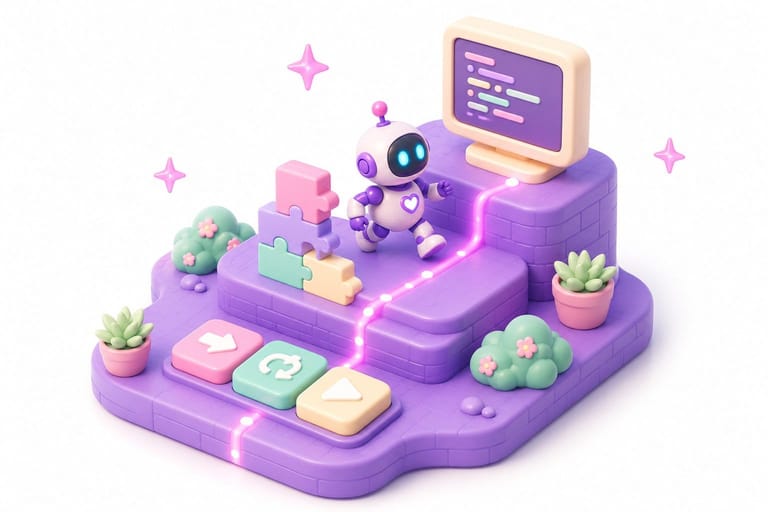
We Built a Free Programming Game for Kids — Here's the Curriculum and Why Tiles Beat Scratch
A free browser-based programming game for kids 7–16 and complete beginners. We explain the 10-concept curriculum and why we bridge tiles → blocks → code instead of starting with Scratch.
What Is IT, Really? A Plain-Language Map of the Four Career Paths
A friendly map of what 'IT' actually means — Frontend, Backend, Data, DevOps — for anyone considering the field. Restaurant analogies, an honest career ladder, and a clear answer to 'am I too old?'
Outside reading — videos we trust
We don't recreate what already exists well. These are the talks our team watches when MCP, agent SDKs, and production AI shipping practices evolve.
 ~6:00:00
 AI Engineer World's Fair 2025 — Day 1 Keynotes & MCP Track (ft. Anthropic MCP team)
The MCP track keynote with the Anthropic team. If you want to understand why MCP became the industry-standard protocol for connecting LLMs to tools in 2025, this is the single best primary source.
 ~2:00:00
 Claude Agent SDK — Full Workshop (Thariq Shihipar, Anthropic)
A hands-on workshop from Anthropic on building production agents with the Claude Agent SDK — tool use, sub-agents, hooks, MCP servers, and the patterns that scale beyond the demo.
 ~8:00:00
 AI Engineer World's Fair 2024 — Keynotes & CodeGen Track
The keynote stream from the largest technical AI conference of 2024. A snapshot of the state of AI engineering — what shipped, what worked, what didn't — straight from the teams building it.
Don't have a track yet?
Three free entry points. No form, no signup.
Open the roadmap
Pick a track in five minutes. The honest version.
See the roadmapBrowse the catalog
29 courses across 4 tracks, every level from Junior to Expert.
Open the catalogAbout Profectus Lab
Why Profectus Lab exists. What we believe. Why a focused expert team, not a marketplace.
Read the storyDon't lose the link
If you read articles like this regularly
Subscribe on TelegramIf you have a question
Send us a messageIf you're not sure where to start
Open the roadmap